Elliptic Curve Taxonomy
Appendix A: Elliptic Curve Taxonomy
Section titled “Appendix A: Elliptic Curve Taxonomy”This appendix provides a comprehensive overview of elliptic curve families used in cryptography, explaining the connection between mathematical properties, algorithmic consequences, and practical utility.
Use Cases: What Are Elliptic Curves Actually For?
Section titled “Use Cases: What Are Elliptic Curves Actually For?”Before diving into curve families, let’s clarify the three main uses of elliptic curve cryptography:
1. Key Exchange (ECDH)
Section titled “1. Key Exchange (ECDH)”“Two parties establish a shared secret over an insecure channel.”
Problem: Alice and Bob need to agree on a secret key for symmetric encryption, but all their communication is monitored.
Solution (Diffie-Hellman):
┌─────────────────────────────────────────────────────────────┐│                    ECDH Key Exchange Flow                    │└─────────────────────────────────────────────────────────────┘
    ALICE                                            BOB    ─────                                            ───
 1. Generate:    secret_a (private)    public_a = secret_a × G                   Generate:                                              secret_b (private)                                              public_b = secret_b × G
 2. Send public_a ─────────────────────────────────────────>
 3. <─────────────────────────────────────────  Send public_b
 4. Compute:    shared = secret_a × public_b          Compute:         = secret_a × secret_b × G        shared = secret_b × public_b                                               = secret_b × secret_a × G
    ✓ Both parties arrive at the SAME shared secret    ✓ Eavesdroppers only see public_a and public_b    ✓ Cannot compute shared without secret_a or secret_b
Alice: secret_a, public_a = secret_a × GBob: secret_b, public_b = secret_b × G
Alice sends public_a → BobBob sends public_b → Alice
Shared secret: Alice computes: secret_a × public_b = secret_a × secret_b × G Bob computes: secret_b × public_a = secret_b × secret_a × G ✓ Same value!Operations needed:
- Scalar multiplication:
k × P - That’s it! No signing, no verification.
Real-world example:
TLS handshake: 1. Browser and server exchange public keys (ECDH) 2. Both compute shared secret 3. Use shared secret for AES encryption2. Signatures (ECDSA, EdDSA)
Section titled “2. Signatures (ECDSA, EdDSA)”“Prove you authorized a message without revealing your private key.”
Problem: Alice wants to sign a transaction. Anyone should verify it’s from Alice, but no one should be able to forge her signature.
Solution:
┌─────────────────────────────────────────────────────────────────┐│              EdDSA Signature Flow (Deterministic)                │└─────────────────────────────────────────────────────────────────┘
SIGNING (Alice - private)          VERIFICATION (Anyone - public)──────────────────────────          ───────────────────────────────
Input: message, private_key         Input: message, signature, public_key   │                                    │   ├─> Hash(private_key || msg)        ├─> Parse signature → (R, s)   │   = deterministic nonce k          │   │                                    ├─> Compute hash challenge   ├─> R = k × G                        │   h = Hash(R || public_key || msg)   │                                    │   ├─> s = k + h × private_key          ├─> Check equation:   │                                    │   s × G ?= R + h × public_key   └─> Output: (R, s)                   │                                        └─> Output: ✓ valid / ✗ invalid
Key Advantage: Deterministic nonce k (no RNG failures!)
Operations needed:
- Point addition:
P + Q - Scalar multiplication:
k × P - Hashing to scalar
- No secret exchange
Real-world example:
Bitcoin transaction: 1. Alice signs: "Transfer 1 BTC to Bob" 2. Network verifies signature using Alice's public key 3. If valid, transaction is included in blockchain3. Encryption (Rarely Used Directly)
Section titled “3. Encryption (Rarely Used Directly)”“ECC is not typically used for encryption directly.”
Why not?
| Issue | Problem |
|---|---|
| Message size | Can only encrypt ~32 bytes at a time |
| Slow | ECC operations are expensive |
| Complex | Requires encoding message as curve point |
What we do instead:
Hybrid encryption (like TLS): 1. Use ECDH to establish shared secret ← ECC 2. Use shared secret as AES key ← Symmetric crypto 3. Encrypt bulk data with AES ← Fast & unlimited sizeBottom line: ECC is used for key exchange, then symmetric encryption handles the actual data.
Curve Families: Mathematical Structure → Practical Use
Section titled “Curve Families: Mathematical Structure → Practical Use”Elliptic curves used in practice fall into three major families (plus one special-purpose category):
| Family | Equation Form | Optimized For | Examples |
|---|---|---|---|
| Weierstrass | y² = x³ + ax + b | General-purpose (legacy) | secp256k1, P-256 |
| Montgomery | By² = x³ + Ax² + x | Key exchange (ECDH) | X25519, X448 |
| Edwards | ax² + y² = 1 + dx²y² | Signatures (EdDSA) | Ed25519, Ed448 |
| Pairing-friendly | Various | Aggregation, ZK proofs | BLS12-381, BN254 |
┌──────────────────────────────────────────────────────────────────────┐│              Elliptic Curve Family Taxonomy Tree                      │└──────────────────────────────────────────────────────────────────────┘
                    ELLIPTIC CURVES (for Cryptography)                               │        ┌──────────────────────┼──────────────────────┐        │                      │                      │   WEIERSTRASS            MONTGOMERY              EDWARDS   y²=x³+ax+b             By²=x³+Ax²+x           ax²+y²=1+dx²y²        │                      │                      │    Use Case:              Use Case:              Use Case:    Signatures +           Key Exchange           Signatures    Key Exchange           (ECDH only)            (EdDSA)        │                      │                      │    ┌───┴───┐                 │                      │    │       │                 │                      │ Generic  Koblitz             │                      │ P-256   secp256k1         X25519                 Ed25519         │                 X448                   Ed448         │    Faster scalar    mult (~30%)
            ┌────────────────────────────────────┐            │      PAIRING-FRIENDLY CURVES        │            │        (Special Purpose)            │            ├────────────────────────────────────┤            │  e: G₁ × G₂ → Gₜ (bilinear map)   │            │                                    │            │  Use Cases:                        │            │  • Signature Aggregation (BLS)     │            │  • Zero-Knowledge Proofs (SNARKs)  │            │                                    │            │  Examples: BLS12-381, BN254        │            └────────────────────────────────────┘
Legend:  [Generic] = General-purpose, many use cases  [Koblitz] = Optimized subclass (endomorphism speedup)  [Montgomery] = x-coordinate only, constant-time ladder  [Edwards] = Complete formulas, deterministic signatures  [Pairing] = Advanced operations, enables aggregation/ZK
Legend:
- Generic = General-purpose, many use cases
- Koblitz = Optimized subclass (endomorphism speedup)
- Montgomery = x-coordinate only, constant-time ladder
- Edwards = Complete formulas, deterministic signatures
- Pairing = Advanced operations, enables aggregation/ZK
Mental model:
- Weierstrass = Swiss Army knife (does everything, but awkward)
- Montgomery = Specialized screwdriver (key exchange only, perfect at it)
- Edwards = Specialized wrench (signatures only, safe & fast)
- Pairing-friendly = Power drill (heavy, but enables new capabilities)
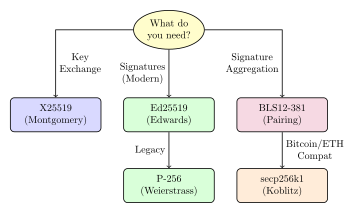
Quick Visual Decision Tree:
1. Short Weierstrass Curves
Section titled “1. Short Weierstrass Curves”“The original form. Powerful, but with sharp edges.”
Equation
Section titled “Equation”y² = x³ + ax + bPrimary Use Case
Section titled “Primary Use Case”ECDSA Signatures (and ECDH key exchange)
Where Used
Section titled “Where Used”- Legacy signatures (Bitcoin, Ethereum EOAs)
- FIPS compliance (P-256, P-384)
- First-generation blockchains
Famous Examples
Section titled “Famous Examples”| Curve | Used By | Primary Use | Notes |
|---|---|---|---|
| secp256k1 | Bitcoin, Ethereum EOAs | Signatures (ECDSA) | Koblitz curve (see below) |
| secp256r1 (P-256) | TLS, WebAuthn, HSMs | Signatures, Key Exchange | NIST standard, FIPS certified |
| secp384r1, secp521r1 | High-security TLS | Signatures, Key Exchange | Larger security margins |
Mathematical Properties
Section titled “Mathematical Properties”- General elliptic curve form (most flexible)
- Group law involves:
- Slope calculation
- Modular inversion
- Multiple special cases:
- Point at infinity
- Point doubling vs addition
- No unified addition formulas
Algorithmic Consequences
Section titled “Algorithmic Consequences”Branch-heavy implementations:
fn add_points(P, Q) { if P == infinity { return Q; } if Q == infinity { return P; } if P == Q { return double_point(P); // Different formula! } if P.x == Q.x { return infinity; // Points are inverses } // General case... different formula again!}┌──────────────────────────────────────────────────────────────────┐│ Point Addition Complexity: Weierstrass vs Edwards │└──────────────────────────────────────────────────────────────────┘
WEIERSTRASS (Branch-Heavy) EDWARDS (Branch-Free)────────────────────────── ─────────────────────
add_points(P, Q) add_points(P, Q) │ │ ├─ P = ∞? ──YES──> return Q │ │ NO ↓ │ │ │ ├─ Q = ∞? ──YES──> return P │ │ NO ↓ └──> ONE FORMULA │ for ALL cases ├─ P = Q? ──YES──> double(P) │ │ NO ↓ │ │ └──> (x₃, y₃) ├─ P.x = Q.x? ──YES──> return ∞ │ NO ↓ │ └──> general_add(P, Q)
Problems: Benefits:• 5 different code paths • 1 unified formula• Timing varies by input • Constant-time friendly• Hard to audit • Fewer bugs• Secret-dependent branches • Easy to verify → timing attacks • No special casesChallenges for signatures (ECDSA):
- Requires fresh random scalar
kper signature - Modular inversion per signature (slow)
- Many corner cases to handle
- Hard to make constant-time
Challenges for key exchange:
- Point validation required (invalid curve attacks)
- More complex than Montgomery curves
- Less clear which coordinate to use as shared secret
Practical Utility for Signatures
Section titled “Practical Utility for Signatures”Why ECDSA fit early systems:
| Feature | Benefit | Use Case |
|---|---|---|
| Public key recovery | (hash, r, s) → pubkey | Smaller blockchain transactions |
| Compact representation | Address = hash(pubkey) | Bitcoin/Ethereum addresses |
| Stateless verification | No need to look up pubkey first | Efficient verification |
| General-purpose | Works for signatures AND key exchange | One curve for everything |
Why blockchains liked them:
- Ethereum transactions only need signature (not public key) → smaller
- Block headers don’t need explicit signer field → simpler
- Compatible with Bitcoin ecosystem
Why They’re Falling Out of Favor
Section titled “Why They’re Falling Out of Favor”For signatures:
| Math Issue | Real-World Failure |
|---|---|
Random k required | RNG bugs leak private keys |
| Modular inversion | Timing side channels |
| Special cases | Consensus bugs, implementation divergence |
| Non-unified formulas | Hard to audit, fragile constant-time code |
For key exchange:
- More complex than Montgomery curves
- Requires careful point validation
- Harder to make constant-time
- Modern systems prefer X25519
Systems analogy: C with undefined behavior — powerful but dangerous in untrained hands.
1.1 Special Case: Koblitz Curves (secp256k1)
Section titled “1.1 Special Case: Koblitz Curves (secp256k1)”Koblitz curves are a special subclass of Weierstrass curves with additional algebraic structure.
What Makes Them Special
Section titled “What Makes Them Special”Efficient endomorphism available:
φ(x, y) = (βx, y)  where β³ ≡ 1 (mod p)
This allows faster scalar multiplication:  kP = k₁P + k₂φ(P)where k₁, k₂ are ~half the bit-length of k
Result: ~30% faster scalar multiplication than generic Weierstrass curves.
Example: secp256k1
Section titled “Example: secp256k1”Why Bitcoin chose it (2009):
- Faster verification → important for 2010-era CPUs
- Smaller private keys → fit well in early wallets
- Good performance on mobile devices
- Small optimization win for a resource-constrained network
Algorithmic Optimization (GLV Decomposition)
Section titled “Algorithmic Optimization (GLV Decomposition)”// Regular scalar mult: k × P requires ~256 point doublings// With endomorphism: split k into (k₁, k₂) each ~128 bits// → compute k₁P + k₂φ(P) with ~128 doublings
fn scalar_mult_glv(k: Scalar, P: Point) -> Point { let (k1, k2) = decompose(k); // Split scalar let phi_P = endomorphism(P); // Efficient map: φ(P) k1 * P + k2 * phi_P // ~30% faster overall}Why They’re Rare Outside Bitcoin
Section titled “Why They’re Rare Outside Bitcoin”| Issue | Impact |
|---|---|
| Niche optimization | Only ~30% speedup (modern CPUs don’t care much) |
| Security assumptions | Relies on specific curve structure (less studied) |
| Complexity | Harder to implement correctly |
| Backwards compatibility | Bitcoin/Ethereum locked in → new chains use simpler curves |
Current Status
Section titled “Current Status”- Still dominant in: Bitcoin, Ethereum EOAs (legacy)
- Rarely chosen for new designs: Ed25519 or BLS12-381 preferred
- Kept alive by: Bitcoin’s massive installed base
Mapping: Algebraic shortcut → speed → long-term complexity debt
2. Montgomery Curves
Section titled “2. Montgomery Curves”“Scalar multiplication specialists.”
Equation
Section titled “Equation”By² = x³ + Ax² + xPrimary Use Case
Section titled “Primary Use Case”Key Exchange (ECDH) — and ONLY key exchange.
Why This Matters
Section titled “Why This Matters”Key exchange needs exactly one operation:
shared_secret = my_private_key × their_public_keyMontgomery curves optimize ruthlessly for this single operation, discarding everything else.
Where Used
Section titled “Where Used”- TLS 1.3 (default key exchange)
- SSH (recommended default)
- VPNs (WireGuard uses X25519 exclusively)
- Secure messaging (Signal, WhatsApp)
Famous Examples
Section titled “Famous Examples”| Curve | Protocol | Adoption |
|---|---|---|
| Curve25519 | X25519 | TLS, SSH, QUIC, WireGuard, Signal |
| Curve448 | X448 | Higher security margin (224-bit security) |
Mathematical Properties
Section titled “Mathematical Properties”- Special curve form optimized for scalar multiplication only
- Works entirely with x-coordinate (y-coordinate not needed!)
- Scalar multiplication uses Montgomery ladder
- Cofactor handled structurally (no explicit checks)
Algorithmic Consequences
Section titled “Algorithmic Consequences”Single, simple algorithm (Montgomery ladder):
fn x25519(scalar: [u8; 32], point_x: [u8; 32]) -> [u8; 32] {    // Montgomery ladder - constant-time by construction    let mut x1 = point_x;    let mut x2 = 1;  // Identity element (x-coordinate)
    for bit in scalar.bits().reverse() {        // Constant-time ladder step (no branching on secrets)        conditional_swap(&mut x1, &mut x2, bit);        x2 = add(x1, x2);   // x(P+Q) from x(P) and x(Q)        x1 = double(x1);    // x(2P) from x(P)        conditional_swap(&mut x1, &mut x2, bit);    }
x1 // Only x-coordinate returned (y not needed!)}┌──────────────────────────────────────────────────────────────┐│ Montgomery Ladder Algorithm (Constant-Time) │└──────────────────────────────────────────────────────────────┘
Goal: Compute k × P where k = 1011₂ (binary: 11 in decimal)
Initial: R₀ = O (identity) R₁ = P
Bit scan (left to right, starting from bit 1):─────────────────────────────────────────────────
Step 1: Process bit 1 (set) R₀ ← R₀ + R₁ = O + P = P R₁ ← 2R₁ = 2P State: R₀ = P, R₁ = 2P
Step 2: Process bit 0 (unset) R₁ ← R₀ + R₁ = P + 2P = 3P R₀ ← 2R₀ = 2P State: R₀ = 2P, R₁ = 3P
Step 3: Process bit 1 (set) R₀ ← R₀ + R₁ = 2P + 3P = 5P R₁ ← 2R₁ = 6P State: R₀ = 5P, R₁ = 6P
Step 4: Process bit 1 (set) R₀ ← R₀ + R₁ = 5P + 6P = 11P ✓ Result! R₁ ← 2R₁ = 12P
Result: k × P = 11P
Key Properties:• Same operations regardless of bit value → constant-time• Only x-coordinates needed throughout• No branching on secret data (k bits)• Conditional swap based on bit, but swap is constant-timeKey properties:
- No branching on secret data (constant-time by design)
- No point addition API exposed (only scalar mult)
- x-coordinate only (simpler, smaller)
- Natural constant-time (algorithm structure enforces it)
Practical Utility for Key Exchange
Section titled “Practical Utility for Key Exchange”Why this is perfect for ECDH:
| Property | Benefit |
|---|---|
| x-only arithmetic | Simpler implementation, smaller keys |
| Montgomery ladder | Constant-time by default |
| No point validation | Algorithm is safe even with invalid points |
| ~200 lines of code | Easy to audit |
| Extremely fast | ~50,000 operations/sec on modern CPUs |
Real-world adoption:
TLS 1.3: X25519 is mandatory-to-implementSSH: X25519 widely deployed as defaultWireGuard: Uses X25519 exclusively (no alternatives)Signal: X25519 for initial key agreementTor: X25519 in v3 onion servicesMapping: x-only arithmetic → simple ladder → side-channel resistance → safe DH
Why It’s NOT Used for Signatures
Section titled “Why It’s NOT Used for Signatures”Signatures need operations Montgomery curves don’t provide:
| Signature Requirement | Montgomery Curve Issue |
|---|---|
Point addition P + Q | Only scalar mult available |
| y-coordinate | Only x-coordinate exists in API |
| Hashing to curve | Complex without full group structure |
| Verification equations | Need full point representation |
Hence: DH yes, signatures no.
What about Curve25519 signatures?
You can’t sign with X25519 directly. Instead:
- Convert to Edwards form → Ed25519
- Same underlying field, different representation
- Ed25519 for signatures, X25519 for key exchange
3. Twisted Edwards Curves
Section titled “3. Twisted Edwards Curves”“Designed for humans, not just mathematicians.”
Equation
Section titled “Equation”ax² + y² = 1 + dx²y²Primary Use Case
Section titled “Primary Use Case”Signatures (EdDSA) — the safe, modern replacement for ECDSA.
Where Used
Section titled “Where Used”- Modern signatures (prioritizing safety over legacy compatibility)
- Secure messaging (Signal, Wire)
- Blockchain (Solana, Cardano, Tezos)
- Infrastructure (SSH, Tor, DNSSEC)
Famous Examples
Section titled “Famous Examples”| Curve | Scheme | Adoption |
|---|---|---|
| Ed25519 | EdDSA | SSH, Signal, libsodium, Solana, Tor v3 |
| Ed448 | EdDSA | Higher security margin (224-bit security) |
Mathematical Properties
Section titled “Mathematical Properties”- Curve form admits complete addition formulas
- No exceptional cases:
P + Q always works (same formula for all inputs)P + P works (doubling)P + infinity worksP + (-P) works
- Efficient representation
- Symmetric group structure
Algorithmic Consequences
Section titled “Algorithmic Consequences”One formula for everything:
fn add_points(P, Q) -> Point {    // Unified addition formula - works for ALL cases:    // - P + Q (general case)    // - P + P (doubling)    // - P + infinity    // - P + (-P)    // NO BRANCHING NEEDED!
    let (x1, y1) = P;    let (x2, y2) = Q;
    let x3 = (x1*y2 + y1*x2) / (1 + d*x1*x2*y1*y2);    let y3 = (y1*y2 - a*x1*x2) / (1 - d*x1*x2*y1*y2);
    (x3, y3)}
Deterministic signature construction (EdDSA):
// EdDSA - no randomness needed!fn sign(message: &[u8], secret_key: &[u8]) -> Signature {    let k = hash(secret_key || message);  // Deterministic nonce    let r = k * G;    let s = k + hash(r || pubkey || message) * secret_key;    Signature { r, s }}
// Compare to ECDSA (dangerous!):fn sign_ecdsa(message: &[u8], secret_key: &[u8]) -> Signature {    let k = random();  // ⚠️ Must be fresh, unpredictable, never reused!    // Single bit of k repetition = private key leaked    // ...}
Practical Utility for Signatures
Section titled “Practical Utility for Signatures”Why EdDSA is safer than ECDSA:
| Math Property | Implementation Effect | Security Benefit |
|---|---|---|
| Complete formulas | No corner-case bugs | Fewer implementation vulnerabilities |
| Deterministic nonce | No RNG failures | Immune to nonce-reuse attacks (PS3, Android) |
| Fast addition | Faster signing & verify | 5-10x faster than ECDSA |
| Small implementations | ~1-2k LOC | Easier to audit, formally verify |
| Constant-time friendly | Branch-free code | Resistant to timing attacks |
Real-world examples:
Signal: Ed25519 for identity keysSSH: Ed25519 recommended default (since ~2014)libsodium: Ed25519 is THE signature primitiveSolana: Ed25519 for all transactionsTor: Ed25519 for v3 onion addressesZcash: Ed25519 for Sapling addressesMapping: Complete group law → branch-free code → fewer exploits → mainstream adoption
Why Edwards ≠ Montgomery (But They’re Related)
Section titled “Why Edwards ≠ Montgomery (But They’re Related)”Same underlying field, different views:
┌───────────────────────────────────────────────────────────────────┐│        Curve25519: Two Views of the Same Underlying Curve         │└───────────────────────────────────────────────────────────────────┘
              SAME UNDERLYING ALGEBRAIC STRUCTURE                   (𝔽p where p = 2²⁵⁵-19)                            │        ┌───────────────────┴───────────────────┐        │                                       │        ↓                                       ↓
 MONTGOMERY FORM                         EDWARDS FORM By² = x³ + Ax² + x                     ax² + y² = 1 + dx²y²        │                                       │   X25519 (ECDH)                          Ed25519 (EdDSA)        │                                       │┌───────┴────────┐                    ┌────────┴─────────┐│ • x-only       │                    │ • Full (x,y)     ││ • Ladder       │                    │ • Complete add   ││ • Key exchange │                    │ • Signatures     ││ • 200 LOC      │                    │ • 2000 LOC       │└────────────────┘                    └──────────────────┘        │                                       │        └───────────────────┬───────────────────┘                            │                  Birational Equivalence                            │                  Conversion formulas:                  ────────────────────                  Edwards → Montgomery:                    u = (1+y)/(1-y)                    v = (coordinate transform)
Protocol Example (Signal):─────────────────────────Identity Key: Ed25519 (signatures) ↓ convertSession Key: X25519 (key exchange)| Montgomery (X25519) | Edwards (Ed25519) | |
|---|---|---|
| Use case | Key exchange | Signatures |
| Operations | Scalar mult only | Full group operations |
| Coordinates | x-only | (x, y) |
| API | scalar * point | sign(), verify(), add(), etc. |
| Formulas | Montgomery ladder | Complete Edwards addition |
| Constant-time | By construction | By design |
Why have both?
- X25519 for ECDH: Simpler, faster, x-only is sufficient
- Ed25519 for signatures: Need full group structure
Think: Montgomery is an optimized syscall; Edwards is a full language runtime.
Can you convert between them?
Yes! They’re birationally equivalent (same curve, different coordinates):
// Convert Ed25519 public key to X25519 public keyfn ed25519_to_x25519(ed_pubkey: EdPoint) -> X25519Point { // Montgomery x = (1 + y) / (1 - y) x25519_key}Used in protocols like Signal that need both operations on the same key material.
4. Pairing-Friendly Curves
Section titled “4. Pairing-Friendly Curves”“Curves that talk to other curves.”
Primary Use Case
Section titled “Primary Use Case”Signature Aggregation & Zero-Knowledge Proofs
Not for basic signatures or key exchange — this is for advanced applications.
Mathematical Properties
Section titled “Mathematical Properties”These support bilinear pairings (a special map between groups):
e: G₁ × G₂ → Gₜ
Key property: e(aP, bQ) = e(P, Q)^(ab)
This bilinearity enables:
- Aggregating many signatures into one
- Verifying complex statements succinctly
- Zero-knowledge proofs
Where Used
Section titled “Where Used”- BLS signatures (signature aggregation)
- Zero-knowledge proofs (zk-SNARKs, zk-STARKs)
- Rollups (verification compression)
- Ethereum consensus (validator signatures)
Famous Examples
Section titled “Famous Examples”| Curve | Used By | Properties |
|---|---|---|
| BN254 (alt_bn128) | Ethereum precompiles, early zk-SNARKs | Fast pairing, 128-bit security |
| BLS12-381 | Ethereum consensus, Zcash, Filecoin | 128-bit security, well-studied |
Algorithmic Consequences
Section titled “Algorithmic Consequences”Enables algebraic “compression” of verifications:
// Without pairings: verify N signatures = N operationsfn verify_signatures(messages: &[Message], sigs: &[Sig], pubkeys: &[PubKey]) {    for i in 0..N {        assert!(verify(messages[i], sigs[i], pubkeys[i]));    }    // O(N) pairing operations}
// With pairings: verify N signatures = 1 operation!fn verify_bls_aggregate(messages: &[Message], agg_sig: Sig, pubkeys: &[PubKey]) {    // Aggregate signature = σ₁ + σ₂ + ... + σₙ    // Verify with SINGLE pairing check:    assert!(e(agg_sig, G₂) == Π e(H(mᵢ), pubkeyᵢ));    // O(1) verification (after linear aggregation)}
Practical Utility
Section titled “Practical Utility”BLS Signatures (Signature Aggregation)
Section titled “BLS Signatures (Signature Aggregation)”| Property | Outcome |
|---|---|
| Bilinearity | Signatures can be added: σ₁ + σ₂ + σ₃ |
| Non-degeneracy | Security holds |
| Efficient pairing | Practical verification |
Ethereum validators depend on this:
32 ETH validators × 1 signature each = 32 signatures (3 KB)          ↓ (BLS aggregation)     1 aggregate signature (96 bytes)
Bandwidth saved: 97% reductionVerification: 1 operation instead of 32
Without BLS aggregation, Ethereum consensus would be impractical.
Zero-Knowledge Proofs
Section titled “Zero-Knowledge Proofs”Pairings allow:
- Succinct verification (proof size independent of computation)
- Constant-size proofs (~200 bytes regardless of statement)
- Efficient proof composition
Real-world impact:
zk-Rollup proof:  - Proves 10,000 transactions are valid  - Proof size: ~200 bytes  - Verification time: ~5ms  - Without pairings: Need to verify all 10,000 txs on-chain
Result: Ethereum L2s can scale to 1000s of TPS
Without pairing-friendly curves, practical zk-SNARKs don’t exist.
Mapping: Bilinear map → algebraic batching → scalability breakthroughs
Trade-offs
Section titled “Trade-offs”Why these curves are “heavy”:
| Aspect | Cost | Comparison |
|---|---|---|
| Arithmetic | ~10-100x slower | vs Ed25519 |
| Key sizes | 48-96 bytes | vs 32 bytes (Ed25519) |
| Complexity | More complex security assumptions | vs simpler ECDLP |
| Setup | Sometimes requires trusted setup | vs setup-free schemes |
But nothing else does this job.
When you need aggregation or ZK, pairing-friendly curves are the only option.
What’s Actually Used Today
Section titled “What’s Actually Used Today”Internet / TLS
Section titled “Internet / TLS”Key Exchange: X25519 (Montgomery) ← Default in TLS 1.3Signatures: Ed25519 (Edwards) or P-256 (legacy)Blockchains
Section titled “Blockchains”Bitcoin/Ethereum EOAs: secp256k1 (Weierstrass/Koblitz) ← LegacyEthereum consensus: BLS12-381 (pairing-friendly) ← ValidatorsEthereum zk precompiles: BN254 (pairing-friendly) ← RollupsSolana: Ed25519 (Edwards) ← ModernCardano: Ed25519 (Edwards)Secure Messaging
Section titled “Secure Messaging”Signal: X25519 (key exchange) + Ed25519 (signatures)WhatsApp: X25519 (key exchange)Noise: X25519 defaultHardware / Compliance
Section titled “Hardware / Compliance”HSMs: P-256, P-384 (Weierstrass) ← FIPS certifiedTPMs: P-256 (Weierstrass)WebAuthn: P-256 (legacy), Ed25519 (growing)Use Case → Curve Family Mapping
Section titled “Use Case → Curve Family Mapping”Quick reference for choosing curves:
| What You Need | Recommended Curve | Family | Why |
|---|---|---|---|
| Key exchange (ECDH) | X25519 | Montgomery | Simple, fast, constant-time by default |
| Signatures (modern) | Ed25519 | Edwards | Safe, deterministic, complete formulas |
| Signatures (legacy/compliance) | P-256 | Weierstrass | FIPS certified, hardware support |
| Signature aggregation | BLS12-381 | Pairing-friendly | Only option for aggregation |
| Zero-knowledge proofs | BLS12-381 or BN254 | Pairing-friendly | Enables succinct proofs |
| Bitcoin/Ethereum compatibility | secp256k1 | Weierstrass (Koblitz) | Ecosystem lock-in |
Design Philosophy Evolution
Section titled “Design Philosophy Evolution”The industry moved from:
“Mathematically elegant curves” (Weierstrass, 1990s-2000s)
to:
“Curves engineered to prevent programmer mistakes” (Montgomery/Edwards, 2010s+)
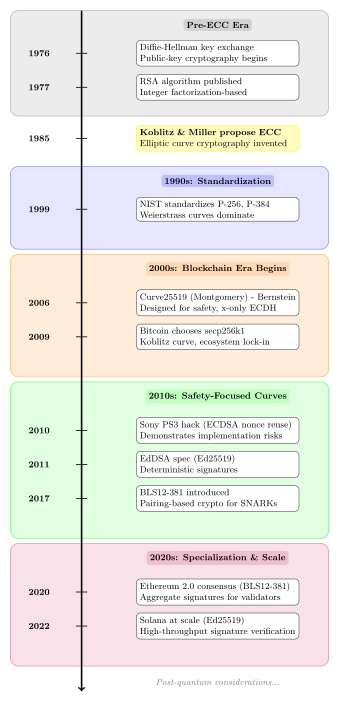
Trend: Generic → Specialized → Advanced
- Generic: Swiss Army knife (Weierstrass)
- Specialized: Purpose-built safety (Montgomery/Edwards)
- Advanced: Power tools for aggregation & ZK proofs (Pairing-friendly)
Key Insights
Section titled “Key Insights”-
Montgomery curves (X25519):
- Minimal API surface → fewer ways to misuse
- x-only → can’t accidentally expose y-coordinate
- Ladder algorithm → constant-time by default
-
Edwards curves (Ed25519):
- Complete formulas → no corner cases to miss
- Deterministic signatures → eliminate RNG dependency
- Small implementations → easier to audit
-
Specialization wins:
- X25519 for ECDH: ~200 LOC, impossible to misuse
- Ed25519 for signatures: ~2000 LOC, safe by default
- vs secp256k1 for both: ~10,000 LOC, many footguns
Systems Analogy
Section titled “Systems Analogy”Think of curve families as APIs shaped by algebra:
| Curve Family | API Design Philosophy | Systems Parallel |
|---|---|---|
| Montgomery | Minimal surface area (only scalar mult) | Microkernel |
| Edwards | Safe general-purpose (complete formulas) | Memory-safe language (Rust) |
| Pairing curves | Power tools (enables new capabilities) | GPU (specialized, powerful) |
| Weierstrass | Legacy compatibility (works but dangerous) | C (powerful, footguns everywhere) |
If You’re Designing a System Today
Section titled “If You’re Designing a System Today”Modern Defaults (2024+)
Section titled “Modern Defaults (2024+)”| Use Case | First Choice | Fallback | Avoid |
|---|---|---|---|
| Key exchange | X25519 | X448 | P-256 ECDH |
| Signatures | Ed25519 | Ed448 | ECDSA (any curve) |
| Aggregation | BLS12-381 | - | Anything else |
| Compliance required | P-256 | P-384 | secp256k1 |
Anti-Patterns to Avoid
Section titled “Anti-Patterns to Avoid”❌ Don’t: Use ECDSA for new designs (use EdDSA instead) ❌ Don’t: Use secp256k1 unless Bitcoin/Ethereum compatibility required ❌ Don’t: Roll your own curve parameters (extremely dangerous) ❌ Don’t: Use the same key for signatures and encryption ❌ Don’t: Use Weierstrass curves for key exchange (use Montgomery instead)
✅ Do: Use X25519 for key exchange ✅ Do: Use Ed25519 for signatures ✅ Do: Use BLS12-381 for aggregation/ZK ✅ Do: Use separate keys for different operations
Summary Table
Section titled “Summary Table”| Family | Equation | Primary Use | Strength | Weakness | Examples |
|---|---|---|---|---|---|
| Weierstrass | y² = x³ + ax + b | Signatures (legacy) | General-purpose | Complex, error-prone | secp256k1, P-256 |
| ↳ Koblitz | (special case) | Signatures (Bitcoin) | ~30% faster | Rare, legacy | secp256k1 |
| Montgomery | By² = x³ + Ax² + x | Key exchange | Simple, constant-time | Key exchange only | X25519, X448 |
| Edwards | ax² + y² = 1 + dx²y² | Signatures | Complete formulas, safe | Incompatible with legacy | Ed25519, Ed448 |
| Pairing-friendly | Various | Aggregation, ZK | Enables new cryptography | Slow, complex | BLS12-381, BN254 |
Further Reading
Section titled “Further Reading”Minichain Documentation
Section titled “Minichain Documentation”- Ed25519 vs secp256k1 comparison — Why Minichain uses Ed25519
- Cryptographic Identities — How addresses are derived
- Transaction Signing — Signature implementation details
Papers & Specifications
Section titled “Papers & Specifications”- Curve25519 paper (2006) — Original Montgomery curve design
- EdDSA paper (2011) — Edwards-curve Digital Signature Algorithm
- SafeCurves — Security criteria for elliptic curves
- BLS12-381 spec — Pairing-friendly curve for zk & consensus
Historical Context
Section titled “Historical Context”- PS3 ECDSA failure (2010) — Nonce reuse attack
- Android Bitcoin wallet vulnerabilities (2013) — Weak RNG